- Front Sight Firearms Training Institute
- Ignatius Piazza – founder of Front Sight
- Ignatius Piazza Blog
- Ignatius Piazza – in Forbes Magazine
- Front Sight – in Black Belt Magazine
- Front Sight – in Icon Magazine
- Front Sight – in The Mail on Sunday Review
- Front Sight – on USA Today
- My Experience at Front Sight
- Ignatius Piazza – in Gun World
- Ignatius Piazza – in Playboy
- Ignatius Piazza – in San Francisco Chronicle
- Front Sight – in Los Angeles Times
- Front Sight – in Cybercast News Service
- Front Sight – in Gun Web
- Ignatius Piazza – in Las Vegas Sun
- Ignatius Piazza – in Small Arms Review
- Front Sight – in Financial Times
- Front Sight – in Sierra Times
- Ignatius Piazza – on World Net Daily
- Ignatius Piazza – in El Mercurio
- Front Sight – on CNN
- Front Sight – in Guns & Ammo
- Front Sight – in New York Times
- Ignatius Piazza – in Times Democrat
- Front Sight – in London Times
- Ignatius Piazza – in Fort Worth Star Telegram
- Ignatius Piazza – in Chicago Tribune
- Front Sight – in Santa Cruz Sentinel
- Ignatius Piazza – in Las Vegas Life
- Ignatius Piazza – in Las Vegas Mercury
- Ignatius Piazza – in Handvapen Guiden
- Ignatius Piazza – in National Enquirer
- Ignatius Piazza – in Las Vegas Review
- Ignatius Piazza – in Washington Post
- Front Sight – in El Pais Seminal
- Ignatius Piazza – on Reform America
- Front Sight – on BBC News
- Front Sight – in US News & World Report
- Front Sight – in Pajaronian Register
Archive for the ‘Warfare’ Category
Front Sight Advanced Training, fourth try!
July 24, 2007Facing the Elephant in Iraq
July 5, 2007Full Story at:
http://www.msnbc.msn.com/id/19591467/
‘World just opened up’
“The whole world just opened up on us, it seemed like,” Cianfrini said in a telephone interview from Iraq. “We zigzagged, whatever we could do, to get out of the guns’ target line. Then we started taking rounds from behind. That . . . took the aircraft down.”
Insurgents attack military helicopters in Iraq about 100 times each month and manage to hit about 17 of the aircraft, using weapons such as heavy machine guns, rocket-propelled grenades and shoulder-fired missiles, according to U.S. officials. Since January, at least 10 American helicopters, including two belonging to contractors, have been shot down. Since October 2001, the Army has lost 33 helicopters to hostile fire in Iraq and Afghanistan.
In a new tactic that has downed several U.S. helicopters in recent months, insurgents use guns mounted on trucks to fire at the choppers from multiple directions. The U.S. military has targeted cells conducting such attacks; on May 31, northwest of the Baghdad airport, U.S. attack helicopters spotted and destroyed insurgents in five trucks outfitted with 14.55mm machine guns.
On Monday, though, insurgents struck again. This account of the events that followed is based on U.S. military interviews, unclassified documents and video footage from the responding aircraft.
“This was a deliberate air ambush,” said Brig. Gen. Jim Huggins, assistant commander of the 3rd Infantry Division, which oversees the volatile region where the helicopter was downed, several miles east of Mahmudiyah.
Hit ground tail first
As it lost altitude, the Kiowa started to shake violently, its main rotor damaged. Burrows said he decided to head into the field but the aircraft began to spin uncontrollably, and at about 20 feet above the ground he had to cut the power. The helicopter hit the ground tail first, bounced over an irrigation canal, crashed nose down and slid into a ditch beside a dirt road.
Cianfrini climbed out one door, and Burrows got out the other. They met at the nose and discovered that they had suffered only scratches, they said. The Kiowa was by then on fire, its engine blowing up inside. Insurgents were shooting from across the field, and the pilots could hear rounds hitting the burning helicopter.
“Where’s your weapon?” Burrows yelled to Cianfrini.
“I have no idea,” came the reply.
Flag marks SEAL’s sacrifice
July 1, 2007Banner that flew in Afghanistan is raised at Capitol
Javier Manzano © The Rocky
Cindy Dietz, right, mother of fallen Navy SEAL Danny Dietz, waits with state Sen. Steve Ward, holding flag, and Colorado State Patrol Trooper Mike Garcia for the start of Thursday’s ceremony honoring her son. “I don’t know what else to say other than we love him,” Dietz said.
By James B. Meadow, Rocky Mountain News
June 29, 2007
The American flag hung motionless in the hazy, breezeless sky, a solemn red-white-and- blue reminder of the man who had sacrificed his life for it two years ago to the day.
For the tourists who took photos and the strolling locals who paid no attention to them, it was a sleepy-quiet Thursday morning on the west steps of the state Capitol. Even the traffic below seemed more lulling than clamorous.
But for Cindy Dietz it was “a very hard day.”
On June 28, 2005, her son, Navy SEAL Danny P. Dietz, was killed on a mission in Afghanistan.
On June 28, 2007, a star-spangled banner that had once flown over Bagram Airfield – Dietz’s base – in that faraway Asian land was hoisted up a 35-foot flagpole that sat on a hill not very far from the Littleton neighborhood where he was born and raised.
Moments before Colorado State Trooper Mike Garcia raised the flag, Cindy Dietz had said softly, “I’m honored. It’s so special to me that this flag was flying over Danny’s base. And now it’s flying in his home state.”
Later, she would overcome her sadness. Summoning up composure and grace, she would stand before the media and say, “Two years ago, my oldest son was killed in Afghanistan.”
A soft hesitation, then, “I don’t know what else to say other than we love him.”
Joining her for the occasion were Danny’s brother, Eric, and his grandmother, Dolores Gilmer, along with a smattering of public officials.
Among them was state Sen. Steve Ward, who not only represents the Dietzes’ district, but who, as a Marine Corps colonel, was stationed at Bagram for two years himself. It was Ward who obtained the flag for the Dietz family.
“He was a brave man who died tragically and heroically,” said Ward, alluding to Petty Officer 2nd Class Danny Dietz being posthumously awarded the Navy Cross – the nation’s second-highest military honor – for his bravery in the face of fierce combat.
The same flag that honored -Dietz will be used Wednesday at the July Fourth dedication ceremony of a statue of him that will be held in Littleton’s Berry Park extension.
But Littleton Police Chief Heather Coogan wasn’t thinking a week ahead as she watched the ceremony.
“This demonstrates that we have so many fine young people who have such a strong sense of duty, honor and patriotism,” said Coogan. “Being here to watch this just feels absolutely right.”
After a long minute, Garcia slowly began lowering the limp flag.
But halfway down, a quicksilver breath of wind caught it. And suddenly, for several blinks of the eye, there it was, spread against the sky: a 3-foot-by-5- foot piece of red-white-and-blue cloth that represented something for which a Colorado warrior was willing to give his life.
If you go
• What: Dedication of the Danny Dietz Memorial Sculpture
• When: 11 a.m. Wednesday
• Where: Berry Park extension, 5507 S. King St., Littleton
• More info: littletongov.org
Staff Sergeant Marcus Golczynski
June 9, 2007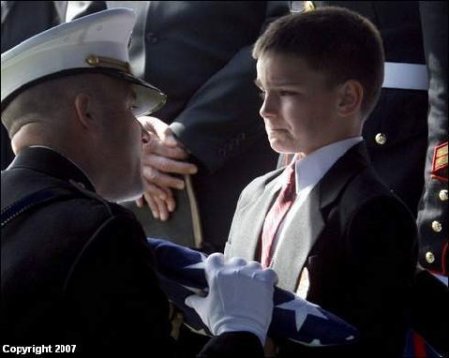 This amazing picture has drawn a lot of comments from readers of the Nashville paper, The Tennessean.
See Jay’s letter below.
Dear Tennessean:
The Tennessean’s April 5 photograph of young Christian Golczynski accepting the American flag from Marine Lt. Col. Ric Thompson is one of the most moving and emotion provoking images I have ever seen.
My wife and I attended funeral services for Christian’s father, Staff Sergeant Marcus Golczynski, on April 4, along with our six year-old son, dozens of Marines, and several hundred others who came to pay tribute to this fallen hero.
As one would expect, many of your readers were touched by this incredible picture. Staff Sergeant Golczynski had previously served one full tour in Iraq . Shortly before his death on March 27 he wrote to his family that he had volunteered to do this a second time due to our deep desire to finish the job we started. In his letter he said, “We fight and sometimes die so that our families don’t have to.” Tragically, Staff Sergeant Golczynski had only two weeks remaining on his second tour. We look at the photograph of Christian every day. It is displayed prominently in our home. Our hearts ache for Christian and for all those who have lost loved ones in this controversial conflict.
Our nation is at a historical crossroads. Do we call an end to the struggle in Iraq or press on? Staff Sergeant Golczynski eloquently told his son how he felt about not giving up. Perhaps there is a lesson for all of us in this man’s life and the choices he made. He was undeniably a man of tremendous courage and conviction. America must now choose whether to complete the job.
When looking at the face of Christian Golczynski I am reminded that doing what is right is not always easy and doing what is easy is not always right. Christian’s dad knew that too.
James
Franklin, TN
Pain and pride. That is what this story reminds me of. In 1959 I was a child and received a flag and medals that my father died for after the Marine Corps finalized the determination that he had died in Korea. Godspeed to you Christian, your father now stands with mine guarding the gates of heaven.
Mitchell Forrest Simmons
June 9, 2007Another warrior from the “Greatest Generation” departed with honors this week. Mitchell Forrest Simmons was 89. He was born and raised in South Carolina. Upon graduating from Clemson, he joined the Marine Corps and attained the rank of Major, after leading assaults at historic battles on Guadalcanal, Peleliu and Okinawa. Mitch conducted his life as an offering, indebted to his Creator, rather than living life as if it were owed to him. He lived to go, not to stay. He fought the good fight and he kept the faith. I knew Mitch since I was a child. He was a great American and will be missed by many, especially his wife, Fran, children, grandchildren and great grandchildren.
Guard the gates of heaven Mitch.
May 22, 2007
Received from a party that I will not identify for his own personal security.
At first I thought this was funny…then I realized the awful truth of it.
Be sure to read all the way to the end!
Tax his land,
Tax his bed,
Tax the table
At which he’s fed.
Tax his tractor,
Tax his mule,
Teach him taxes
Are the rule.
Tax his cow,
Tax his goat,
Tax his pants,
Tax his coat.
Tax his ties,
Tax his shirt,
Tax his work,
Tax his dirt.
Tax his tobacco,
Tax his drink,
Tax him if he
Tries to think.
Tax his cigars,
Tax his beers,
If he cries, then
Tax his tears.
Tax his car,
Tax his fuel,
Find other ways
To tax the fool
Tax all he has
Then let him know
That you won’t be done
Till he has no dough.
When he screams and hollers,
Then tax him some more,
Tax him till
He’s good and sore.
Then tax his coffin,
Tax his grave,
Tax the sod in
Which he’s laid.
Put these words
upon his tomb,
“Taxes drove me to my doom…”
When he’s gone,
Do not relax,
Its time to apply
The inheritance tax.
Accounts Receivable Tax
Building Permit Tax
CDL license Tax
Cigarette Tax
Corporate Income Tax
Dog License Tax
Firearms Tax
Excise Taxes
Federal Income Tax
Federal Unemployment Tax (FUT A )
Fishing License Tax
Food License Tax,
Fuel permit tax
Gasoline Tax (42 cents per gallon)
Gross Receipts Tax
Hunting License Tax
Inheritance Tax
Interest expense Tax
Inventory tax
IRS Interest Charges IRS Penalties (tax on top of tax)
Liquor Tax
Luxury Taxes
Marriage License Tax
Medicare Tax
Personal Property Tax
Property Tax
Real Estate Tax
Service charge taxes
Social Security Tax
Road usage taxes
Sales Tax
Recreational Vehicle Tax
School Tax
State Income Tax
State Unemployment Tax (SUT A )
Telephone federal excise tax
Telephone federal universal service fee tax
Telephone federal, state and local surcharge taxes
Telephone minimum usage surcharge tax
Telephone recurring and non-recurring charges tax
Telephone state and local tax
Telephone usage charge tax
Utility Taxes
Vehicle License Registration Tax
Vehicle Sales Tax
Watercraft registration Tax
Well Permit Tax
Workers Compensation Tax
COMMENTS: Not one of these taxes existed 100 years ago, and our nation was the most prosperous in the world.
We had absolutely no national debt, had the largest middle class in the world, and Mom stayed home to raise the kids.
What the happened? Can you spell “politicians!”
And I still have to “press 1” for English.
I hope this goes around THE US A at least 100 times
Friends, this was written by a 59 year old man that earned an MBA in Economics many years ago. He is also a Viet Nam Veteran that served in the 75th of the 101st Airborne. He will soon die. Let us never forget these words of wisdom.
The Caste of Warriors
May 22, 2007Source: http://www.msnbc.msn.com/id/18796642/
It is said that there are those that are Warriors that do not know that they are Warriors. It should also be noted that many, simply do not recognize a Warrior for what He is.
Ladies, and Gentlemen; Here is a simple fact: “Know a Warrior by His deeds.”
By Hector Gutierrez
Rocky Mountain News
May 22, 2007
If the Army needed someone to write a manual about winning the hearts and minds of children during war, it could have turned to Sgt. 1st Class Scott J. Brown.Brown reached out to children during the war in Iraq, and was good at it, his family said Monday. By nature he loved children. Brown had a son, two daughters, and nephews and nieces who adored him, his family said.
Brown took it upon himself to create his own outreach project, with family members sending him stuffed animals, toys and games that he could hand out to Iraqi youngsters who were devastated by war and may have built some mistrust of American soldiers.
“When he was in Iraq, he asked me to send boxes of stuffed animals so that he could hand them out to the children,” his sister, Debbi Hood, said. “I guess it was a way for soldiers to show the children of Iraq that Americans were safe and good people. They built their trust that way . . . He felt sorry for them.”
Brown, 33, died Friday in Iraq after he was hit by small-arms fire, the Defense Department said.
He was the second soldier with Colorado ties to be killed last Friday.
Sgt. Ryan J. Baum, 27, of Aurora, also died of wounds he suffered from small-arms fire, the department said. Baum was assigned to the 3rd Battalion, 509th Infantry Regiment, 4th Brigade Combat Team, 25th Infantry Division, Fort Richardson, Alaska.
In addition to Operation Iraqi Freedom, Brown toured other world hot spots, including Afghanistan, Kuwait and Kosovo.
When he married his wife, Delilah, nearly two years ago, Brown was deployed again to serve in Afghanistan and then two more tours in Iraq. He saw his wife for only about four months during the couple’s nearly two years of marriage.
“You could see by his rank that he was an awesome soldier for only being in the Army for nine years,” his family said in a statement.
“Scott was always so humble about his job and didn’t like to be considered a hero. He said, ‘I am just doing my job for my country and so my family can live in a land of freedom.’ “
Brown grew up in Brookfield, Wis., and was a huge Packers fan, his family said. He graduated from Brookfield Central High School, but moved to Fort Collins, where he lived with his sister for about a year and a half.
His sister remembered that while growing up, he sometimes talked about following in the footsteps of his late father, Vernon Brown, who served in the Korean War. At 24, Scott Brown enlisted.
He was assigned to Fort Benning, Ga., later moved to Fort Hood, Texas, then deployed to Kosovo and Kuwait.
He eventually made it into airborne and was assigned with the 1st Battalion, 325th Airborne Infantry Regiment, 2nd Brigade Combat Team, 82nd Airborne Division in Fort Bragg, N.C.
Funeral services for Brown are expected to be held in Milwaukee.
In addition to his sister, Brown is survived by his wife, Delilah, son, Taylor (TJ), and stepdaughters, Vicki and Cassie; his mother, Lynne, stepfather, Lory Ferguson; and his brother, Michael.
“Scott would do anything for anybody, especially when it had to do with kids,” his family’s statement read. “His heart was as big as his dedication to his country. He never let us worry about him and always assured us that he would be fine.”
I submit that this man was a Warrior.
Fallen Marines Guard the gates of Heaven. Paratroopers guard the paths to the gates.
Tears for Valor
May 12, 2007There are times when one must simply admire the courage and unadulterated Valor of our children. This young man saved so many American lives that, if it were in the early days of World War Two he would have been sent home to raise money and awareness of the foe that we faced.
Many serve (much too few) and all are to be admired. Yet? Among them, a cream arises. American Warriors. No better friends, and no worse enemies.
Lance Cpl. Christopher Adlesperger now guards the gates of heaven. Have a beer with Chesty.
Profiles of valor: Lance Cpl. Adlesperger
Lance Cpl. Christopher Adlesperger of Albuquerque, New Mexico, was on a “clearing mission” in Fallujah with Kilo Company, 3rd Battalion, 5th Marines, when he and his team encountered heavy enemy fire. His point man was killed and two other Marines were injured. Despite shrapnel wounds, Adlesperger advanced the attack against the jihadis, while single-handedly clearing the stairs and moving the wounded to safety. According to the citation on his award, “On his own initiative, while deliberately exposing himself to heavy enemy fire…[Adlesperger] established a series of firing positions and attacked the enemy, forcing them to be destroyed in place or to move into an area where adjacent forces could engage them.”
A month after the Fallujah battle, the 20-year-old Adlesperger was on another clearing mission when he was killed by enemy gunfire.
For his courageous actions in Fallujah, Adlesperger was posthumously awarded the Navy Cross, the second highest military medal for combat valor. His family was presented with the medal at a recent award ceremony. Adlesperger’s actions “destroyed the last strongpoint in the Jolan District of Al Fallujah and saved the lives of his fellow Marines…” the citation states. “By his outstanding display of decisive leadership, unlimited courage in the face of heavy enemy fire and utmost devotion to duty… Adlesperger reflected great credit upon himself and upheld the highest traditions of the United States Marine Corps and the United States Naval Service.”
Patriots, please pray for the family of Lance Cpl. Adlesperger.
Hat tip to the Patriot Post
Know Thine Enemy
February 20, 2007“The latent causes of faction are thus sown in the nature of man.” —James Madison
Friday Digest
PATRIOT PERSPECTIVE
On Sunnis and Shi’ites
After publishing an op-ed entitled “The Real Islam” last summer, I was bombarded by requests to produce a follow-up piece outlining the differences between Sunni and Shi’ite Muslims. Well, here it is, with one caveat: The historical complexities and theological nuances of the 1,400-year-old rift in Islam make the 600-year division between Roman Catholicism and Protestantism, or the contemporary divisions within Protestantism, seem simple by comparison. There is no way a thousand-word essay can say it all. Thus, though I may outline these differences in a nutshell, I’m certain to leave countless other nuts yet to be cracked.
Muslims today make up about one person in four, some 1.4 billion altogether. Of these, nearly 90 percent are Sunni; the remaining 10 percent are primarily Shi’ite. Of the world’s 52 majority-Muslim states, only five are majority Shi’ite: Iran (90 percent), Azerbaijan (80 percent), Bahrain (70 percent), Iraq (66 percent) and Lebanon (50 percent). With minor exceptions, the rest are majority Sunni. These facts notwithstanding, Shi’ite Muslims exert an influence in the Muslim world and beyond that transcends their comparatively meager numbers.
As both friend and foe, Shi’ite Iraq has been a focal point of U.S. foreign policy for at least three decades. Iran’s enormous oil wealth, hard-line theocracy and pursuit of nuclear weapons continue to pose problems for the Middle East and the West. Azerbaijan’s post-Soviet dictatorship not only enjoys enormous oil and natural-gas wealth, but also functions as an unavoidable corridor for oil transport between Russia, Central Asia, Europe and the Middle East. Bahrain hosts a key U.S. naval base and enjoys a reputation as a strong and growing world financial hub. Lebanon, once the Westernized gem of the Middle East, is now plagued by Hizballah and Syrian interference but continues to hold a pivotal role regarding Israeli security and regional democratization. For better or for worse, the Shi’ites cannot be ignored.
Two prevailing issues lend urgency to our understanding of these, the two great sects of Islam. First, as Congressional Quarterly’s Jeff Stein demonstrated in a series of biting reports over the past several years, even the most senior and seasoned U.S. legislative, foreign-policy, intelligence and law-enforcement leaders have next to no understanding of the differences between Sunnis and Shi’ites, what countries are dominated by which sect, or why it matters. Second, as is so readily apparent in Iraq today, Sunnis and Shi’ites have little compunction when it comes to slaughtering each other. This is because each considers the other heretical—that is, outside the oma or community of true Islam.
Across the entire Muslim world, it’s dangerously naive to think that the differences between Sunnism and Shi’ism are all that matter; in fact, it’s far more complicated. Yet given that these differences do matter, what are they?
It is no small detail that the rift between Sunnis and Shi’ites dates to the death of Muhammad, Islam’s founder. Shortly before his own death in 632 AD, Muhammad’s last surviving son, Ibrahim, also died. By this time, Islam was already tightly woven into a religious and political community led by a man who was at once both a religious and political leader. In the absence of an heir apparent, the question of succession—who would lead Islam after Muhammad—quickly engulfed this nascent but powerful Islamic oma.
The term Sunni comes from the Arabic word sunna, which roughly translates as “example,” indicating those who follow the example of Muhammad. Sunnis refer to themselves properly as Ahlus Sunnah wal-Jamaa’h, roughly “the people of the example [of Muhammad] and the community.” The name is meant to connote their own claim as the heirs of “orthodox” Islam and as the majority among competing Muslim sects.
The name was chosen because Sunnis believed themselves to be following the example of Muhammad in several key respects. Muhammad, they say, did not designate a successor or dictate a procedure for selecting one. Also, Muhammad’s claim to prophethood was unique—his successor would be a leader of the community, not another prophet. Finally, what was clear was that Islam should remain united under one individual—a leader of the oma, a military commander and the final arbiter of disputes within the community and interpreter of its law. Implicit in these assertions was the belief that Islam’s leader need not come from a particular family, clan or tribe.
Consequently, Abu Bakr, one of Muhammad’s inner circle and among the first converts to the new religion, became Islam’s first leader, or caliph. Serving as caliph from 632 to his death two years later, Abu Bakr was the first of whom Sunnis recognized as the four “Rightly Guided Caliphs.” Before his death, Abu Bakr named another of Muhammad’s inner circle, Umar, as his successor. Umar ruled as caliph to his death in 644, during which time he created a sort of electoral college to choose future successors. This group chose Uthman as Islam’s third caliph (644-656), followed by Ali, Muhammad’s son-in-law and cousin, who held the title until his death in 661. The caliphate continued after Ali but was marked by increasing political disunity and corruption through several dynasties, causing Muslims to look back on the era of its first four caliphs as the “Golden Age” of Islam.
Golden to the Sunnis, that is. The Shi’ite minority, by contrast, considered Ali as the rightful heir of Islam, designated as such by Muhammad himself. The intervening three leaders—Abu Bakr, Umar and Uthman—were, therefore, illegitimate. They stole Ali’s position from him, Shi’ites say, despite all three having been present when Muhammad allegedly designated Ali as his successor at the oasis of Ghadir al-Khumm.
For the Shi’ites, Ali was no mere caliph; to them, he enjoyed a similar—but not identical—prophetic status as Muhammad before him. Whereas Muhammad received revelation from Allah (wayh), Ali and his successors received divine inspiration (ilham) allowing them to guide and judge Islam sinlessly, both spiritually and politically. Thus, for Shi’ites—also called Shi’a Ali, the “party of Ali” —Ali is the first imam, the leader of the oma descended from Muhammad. To them, the Imamate, not the Caliphate, is the rightful ruler of Islam.
In 874, Muhammad al-Qa’im became the twelfth imam at the age of six, and the end of Muhammad’s line. Shi’ites claim that for the next 67 years he existed in a state of “lesser occultation,” where he was directly accessible to his followers, followed by an inaccessible “greater occultation” which will continue until the Last Days. When this “Hidden Imam” is again revealed, he will initiate an apocalyptic struggle against the foes of Islam, hailing the end of the world. In the meantime, the rule of Islam resides in the ayatollahs, the “sign of Allah,” who act in the name of the Hidden Imam.
In the lead up to the 1979 Iranian revolution, the Ayatollah Khomeini never directly claimed to be this Hidden Imam, but his followers propagated the idea in order to legitimize Khomeini’s claim against the secular government of the pro-Western Mohammad Reza Pahlavi, Shah of Iran, and to consolidate power after the Shah’s exile. Today, Iranian President Mahmud Ahmadi-Nejad purports to be making preparations for the Imam’s second coming, which he believes to be close at hand. While Ahmadi-Nejad is doubtless a true believer, this claim may be intended to buttress the hard-line theocracy’s often-tenuous rule in Iran, as well as helping mobilize fellow Shi’ites across the border in Iraq.
There, Shi’ite-Sunni relations will be at the heart of conciliation or disintegration—whichever may occur. Indeed, religious, ethnic and tribal divides define four conflicts being simultaneously waged in Iraq today: Shi’ite on Shi’ite violence in the south; Shi’ite-Sunni sectarian violence in Baghdad; Ba’athist-inspired violence against the government; and al-Qa’ida/jihadist violence against anti-Western Shi’ites and the pro-U.S., Shi’ite-dominated government.
While religious violence is not the exclusive cause of the violence in Iraq, without it the conflict would be greatly simplified and far more manageable. As it is, working to quell one of Iraq’s conflicts often has the result of inflaming another.
It may be an oversimplification to say so, but a Vatican II-styled resolution between Sunnis and Shi’ites may be just what the Muslim world—and the rest of the world—needs most.
Credit: Patriot Vol. 07 No. 07 | 16 February 2007 | PatriotPost.US |
Welcome Home!
February 18, 2007I am not alone in fully supporting our troops. Even if the media refuses to do so.


 Conservative Libertarian Outpost