Archive for the ‘Hunting Fishing and the Great Outdoors’ Category

Wildlife, Politics do mix

January 22, 2008

Source: http://www.rockymountainnews.com/news/2008/jan/22/dentry-wildlife-politics-do-mix/

Here is a great way for those that truly are interested in Colorado and it’s wildlife. many challenges face hunters and fishermen here in the Centennial State. Misconceptions abound, and Mister Dentry’s reference to so called “canned” hunts fails to address thew actual scope of the legislation that is being proposed. As is stands, if your farm is fenced, you will not be allowed to hunt on it, and that is only one example.

GB 1137 is piss poor legislation whether it is supported by Republicans or not. Republicans have also sponsored immoral Ex Post Facto Law based solely upon political correctness, so go figure.

Here are my biggest issues regarding hunting and fishing in Colorado. They are not in any particular order, and no one is of greater importance than any other issue.

  • We are constantly bombarded with messages from all over that the younger generation is the future of outdoor recreation. “Take a kid fishing,” and that sort of thing. Has anyone noted that the cost of licenses has become prohibitive for a lot of people over the past few years?
  • Two years ago, I bought a license for a friend of mine so that I would have a hunting partner for big game season; He was, and is broke secondary to an abusive child support order. They took my money, that I spent, and used it toward his support order. Screw the powers that be, that was theft.
  • Access, while greatly improved over the past few years, still is a problem. See bullet number one…
  • I had family from out of state come and visit. We went fishing, and a DOW officer stopped by. Gone are the days of chatting with a friendly Warden, he was a grump, and was only concerned with legalities. Law enforcement is a legitimate part of the job, but so is proper interaction with the public at large. My relatives will no longer purchase expensive non resident licenses in Colorado. Now they go to Wyoming. Where “The people are so friendly.”

ZEBRA MUSSELS DETECTED IN LAKE PUEBLO STATE PARK

January 20, 2008

ZEBRA MUSSELS DETECTED IN LAKE PUEBLO STATE PARK

Recent sampling efforts between the Colorado Division of Wildlife (DOW) and Colorado State Parks personnel detected the presence zebra mussels at Lake Pueblo State Park. Two adult mussels and one immature specimen were found on substrate sampling gear, and the larva (veliger) was found by performing plankton tows.

The DOW and Parks personnel have been conducting field sampling efforts for several years to evaluate waters across Colorado for the presence of aquatic invasive species. These efforts are targeted toward locating and monitoring potential introductions of invasive species that can be environmentally and economically detrimental to the state, its wildlife and recreation resources.

Additional sampling at Lake Pueblo State Park to determine the degree of infestation and exact mussel species is planned for this winter and spring. State Parks and the DOW are planning a concerted effort to notify recreational users at Pueblo Reservoir, and other state parks, about the potential impacts of zebra mussels.

The Pueblo State Fish Hatchery, which receives its water supply from Pueblo Reservoir, will undergo an assessment regarding options to prevent the spread of adult mussels and/or veligers. Sampling inspections have been conducted to determine if zebra mussels or larvae are present in the hatchery unit, to date none have been detected.  Pueblo Hatchery raises a variety of warm and cold water species of fish (walleye, bluegill, crappie, channel catfish, smallmouth bass, wiper, rainbow, cutthroat X rainbow hybrid, and brown trout) and distributes these fish across the state each year. No fish are planned to be stocked from the Pueblo Hatchery until April this year. Effective water treatment options exist to eliminate zebra mussel adults and/or veligers prior to the fish being stocked.

All boaters and other water craft recreational users should take simple, precautionary steps every time they go to a lake, river or stream.

Before leaving a lake or other waterway, always:  

  • CLEAN the hull of your boat.
  • DRAIN the water from the boat, livewell and the lower unit of the engine.
  • DRY the boat, fishing gear, and equipment.
  • INSPECT all exposed surfaces.
  • REMOVE all plant and animal material.

Remember, many of these aquatic hitchhikers can harm your boat as well. These invaders will attach themselves to boats and can cause damage to boat motors if they block the flow of cooling water through the engine.

However, zebra mussels do not pose a known threat to human health. Biologists are concerned that zebra mussels may cause ecological shifts in the lakes they invade, with consequences to valued wildlife resources.   Because these invasive mussels attach to hard surfaces like concrete and pipes, they will affect canals, aqueducts, water intakes and dams, resulting in increased maintenance costs for those facilities.  

The zebra mussel gets its name from the black- (or dark brown) and white-striped markings that appear on its shell. Zebra mussels are native to the Caspian, Black, and Azov seas of Eastern Europe.  
These exotic mussels were first discovered in the United States in Lake Saint Clair, Michigan, in 1988 and are believed to have been introduced in 1986 through ballast water discharge from ocean-going ships. Since their initial discovery, zebra mussels have spread rapidly throughout the Great Lakes and Mississippi River Basin states and other watersheds throughout the eastern and central United States.

The primary method of overland dispersal of these mussels is through human-related activities. Given their ability to attach to hard surfaces and survive out of water, many infestations have occurred by adult mussels hitching rides on watercraft. The microscopic larvae also can be transported in bilges, ballast water, live wells, or any other equipment that holds water. 

They are primarily algae feeders.  They feed by filtering up to a liter of water per day through a siphon. These mussels consume large portions of the microscopic plants and animals that form the base of the food web. The removal of significant amounts of phytoplankton from the water can cause a shift in native species and a disruption of the ecological balance a lake or other waterway.

These mussels can settle in massive colonies that can block water intake and affect municipal water supply and agricultural irrigation and power plant operation.  In the United States, Congressional researchers estimated that zebra mussels alone cost the power industry $3.1 billion in the 1993-1999 period, with their impact on industries, businesses, and communities more than $5 billion.

For more information, visit www.100thmeridian.org.    

I might add that waders need to be well rinsed also.

VOLUNTEER OPPORTUNITIES IN PUEBLO

January 13, 2008

Volunteers are needed to assist the Colorado Division of Wildlife (DOW) manage Colorado’s wildlife and perform a variety of duties that benefit wildlife.
 
The DOW will host a new volunteer orientation January 19 from 10 a.m. until noon in the auditorium at Lake Pueblo State Park.
 
This two-hour session will cover different volunteer opportunities throughout the year where people can get involved in local wildlife projects. 
 
DOW volunteers assist in a variety of ways.  A sample of the kinds of projects include: Eagle Day Feb. 2; wildlife transport (training is 2/16); hatchery tours (training in March); walleye spawn (3/15); ongoing projects at the Bosque del Oso and Pueblo State Wildlife Areas; and bluebird and osprey habitat improvement projects (March training). 
 
The orientation will highlight different volunteer opportunities available for 2007 and will give registered volunteers the chance to sign up for future projects.  For more information, contact Jena Sanchez at (719) 227-5204. 
 
The Colorado Division of Wildlife is the state agency responsible for managing wildlife and wildlife habitat, as well as providing wildlife related recreation and maintaining a balance between human activities and wildlife.  Funding for the Division of Wildlife comes from the sale of hunting and fishing licenses and the habitat fees collected in conjunction with those sales.  The Division does not receive tax dollars from the Colorado general fund.

For more information about Division of Wildlife go to: http://wildlife.state.co.us.

COLORADO RESIDENTS URGED NOT TO FEED DEER

January 13, 2008

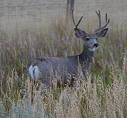
muledeerbuck2.jpgThe Colorado Division of Wildlife urges state residents and visitors not to feed deer that are hanging around their yards or property.
 
“Deer require a very specific diet,” explained Don Masden, a biologist for the Colorado Division of Wildlife. “If they eat the wrong food they’ll just die with a full stomach.”
 
Deer digest very slowly and if they eat the wrong types of food and too much food they will not be able to digest or pass the material and they will die. So, deer should not be fed hay, pet food, fruits, vegetables or any type of table scraps.
 
If you have sage brush or other shrubs on your property, knock the snow off of those to expose some natural food for the animals.
 
“Feeding deer the wrong food will cause more harm than good,” Masden said.
 
Deer are most affected by the severe winter conditions that western Colorado is experiencing this year. But no food should be provided to any big game, officials emphasized.
 
Elk and bighorn sheep are better adapted to survive severe winters. Elk can eat a wider variety of material and because of their size can push and dig through deep snow to find food. Bighorn sheep live in steep areas that don’t hold snow, so they are not as affected by the snow depth.
 
The DOW will be conducting a winter feeding operation aimed at deer in the Gunnison Basin. A feed developed specifically for deer that has been formulated by DOW scientists will be used.
 
The DOW office will attempt to make some of that feed available to property owners. However, feed will not be delivered to the Gunnison office until sometime next week. Residents are asked to wait until mid-week to inquire about available feed. 
 
So far deer in the Gunnison Basin are in pretty good shape given the weather conditions. But based on past experience, wildlife managers know that the weather could soon start to take its toll on deer.
 
The DOW is looking for volunteers to help with the feeding effort. Those who can volunteer for several days should call Jennifer Kleffner, southwest volunteer coordinator, at (970)375-6704.

For more information about Division of Wildlife go to: http://wildlife.state.co.us.

DIVISION OF WILDLIFE TO CONDUCT EMERGENCY BIG GAME FEEDING OPERATION IN GUNNISON AREA

January 11, 2008

bull-elk1.jpgDIVISION OF WILDLIFE TO CONDUCT EMERGENCY BIG GAME FEEDING OPERATION IN GUNNISON AREA


The Colorado Division of Wildlife is planning to start emergency feeding operations for big game animals in the Gunnison Basin as soon as possible.
 
Deer will be targeted primarily because they are most affected by adverse weather conditions. Feed and hay will also be provided to bighorn sheep, pronghorn and elk.
 
Providing feed to wildlife requires a major effort and the DOW is seeking volunteers to help. DOW wildlife managers are now working on the logistics of the operation. While some feeding will start as soon as material is available, the effort will increase as feed – specially formulated for deer – becomes available from a mill next week.
 
Wildlife officials are concerned that deep snow and extremely cold temperatures in the Gunnison basin are causing deer to deplete their energy reserves too early this winter. Without supplemental food, mortality could reach unacceptable levels. The snowpack in the Gunnison Basin is now at 143 percent of average. It is difficult for deer to push through deep, crusted snow to get to natural food sources. Big game animals lose 30 percent of their body weight during a normal winter. When they lose more than that their survival can be severely compromised.
 
In the Gunnison area, there are about 260 bighorn sheep in several herds where feed could effectively be delivered. Bighorns winter in steep terrain that doesn’t usually hold snow, so they are not as affected by the snow depth.
 
About 600 pronghorn also live in the area and efforts will be made to feed them. Unfortunately, the DOW has had limited success in getting pronghorn to take supplemental feed. The DOW will attempt to feed them with smaller wafers that have worked previously. 
 
“So far, deer appear to be in pretty good condition for this time of year given the current weather and snow depth,” explained J Wenum, area wildlife manager in Gunnison.
“We haven’t seen any weather-related mortality to speak of yet. But from experience we know that the snow conditions could soon start to take a toll on deer.”
 
Officials from the Bureau of Land Management, the U.S. Forest Service and Gunnison County are helping the DOW develop strategies for the emergency feeding plan. The DOW would also like to work with private landowners to establish feeding sites.
 
Deer have more specific nutritional needs than elk and cannot survive on hay. The feed formulation that will be used was developed after extensive nutritional research by DOW years ago.  Ingredients include wheat and other grains, dehydrated alfalfa and cottonseed meal. The feed is formulated into wafers so that it will stay on top of the snow. Deer will receive about 3 pounds of the feed per day.
 
“We will not be trying to feed every deer in the Gunnison Basin. We will be looking for areas where the animals are most concentrated and where we can derive the most benefit,” Wenum said.
 
Wildlife managers will work to keep deer and elk separated. The DOW plans to provide hay to elk – but not because they need it to survive. Elk are aggressive and will quickly displace deer if easy food is available. Placing hay in specific areas will help keep them away from deer feeding areas. Hay may also be placed to move elk away from ranchers’ hay stacks or highways.
 
Because deer derive very little nutritional value from hay, homeowners and landowners are urged not to feed hay to deer that gather on their property.
 
The feeding operation will probably continue through February or until conditions moderate. By early March officials hope the weather will be getting warmer and that natural forage areas will open up. Big game animals prefer natural forage and will move to those areas as soon as they become available.
 
Previous winter feeding operations were conducted in the Gunnison area in 1984 and 1997.
 
Volunteers will be needed for a variety of jobs. To haul feed the DOW needs trailers and a substantial number of vehicles that can handle snowy conditions, especially snowmobiles, snowcats and four-wheel drive vehicles. Volunteers also are needed who can travel through deep snow on cross-country skis and snowshoes.
 
Volunteers who want to help in the Gunnison area should contact Jennifer Kleffner, southwest region volunteer coordinator at (970)375-6704.
 
Wildlife managers are also monitoring weather and snow conditions in other areas of western Colorado, including the Eagle Valley, the Aspen area, the Meeker/Craig area and the lower Yampa Valley. 
 
Throughout western Colorado travelers are urged to watch carefully for wildlife along roads. As snow accumulates animals will move toward open areas. The DOW also requests that people avoid disturbing wildlife at this time of year. Do not attempt to get close to animals; observe them at a distance using binoculars or a spotting scope. If they are forced to move they will expend energy unnecessarily.
 
#   #   #
 
 
The Colorado Division of Wildlife is the state agency responsible for managing wildlife and its habitat, as well as providing wildlife related recreation. The Division is funded through hunting and fishing license fees, federal grants and Colorado Lottery proceeds through Great Outdoors Colorado.
 

For more information about Division of Wildlife go to: http://wildlife.state.co.us.

A different kind of rescue assignment

December 21, 2007

WILDLIFE OFFICERS, COUNTY EMERGENCY WORKERS RESCUE ELK

In one of the most unusual emergency operations in Colorado this year, three cow elk that fell through the ice of a private pond south of Pagosa Springs were rescued by Division of Wildlife officers, a local volunteer fire fighter and ten other law enforcement workers. The rescue occurred on Dec. 15.
 
Another elk, a young spike bull, died in the pond during the effort.
  
It is not uncommon for big game animals to break through ice during winter while searching for water. But it’s not common for the animals to be rescued.
    
James Romero, a DOW officer, received a call from the Colorado State Patrol about 8:30 a.m. and was told about the animals struggling in the pond. The call also went out to Archuleta County emergency operations. Staff from the sheriff’s office, the Pagosa Fire Protection District, the Pagosa Springs Police Department and Upper San Juan Search and Rescue also went to the scene and all arrived within a few minutes of each other.
  
The elk, apparently, had seen open water in what was the middle of the pond. When they moved to the edge the ice broke under their weight. Romero estimated that the animals weighed from 300 to 500 pounds each. 
 
“I think they’d probably fell in earlier in the morning,” Romero said. “They were panicked and struggling, but appeared they had enough energy to last awhile.”
  
One of the people who came to the scene was Thad McKain, a volunteer with the Pagosa Fire District who is certified to perform ice rescues. He had been called by the search and rescue workers. They carry two suits designed for ice rescues in their truck. 
  
McKain said he’d been involved with three rescues of dogs on ice, but had never been called on to save wildlife.
 
“We put the suits on and I gave James a crash course about what to do,” McKain said.
  
Without the suits, rescue of the animals might not have been possible.
  
Secured by ropes, the two men moved to the edge of the water with an ax and broke some ice away to make a narrow slot into which they hoped to guide the elk. On the bank the 10 others stood to help.
 
“Then we just started making things up as we went,” said Mike Reid, another local DOW wildlife officer who helped with the rescue.
  
Romero, who had never attempted to rescue a big game animal before, wasn’t sure what to expect as he moved toward the elk. When he got to the edge of the ice, one of the cow elk swam to him.
 
“I was surprised. I didn’t anticipate that, she came right up to me and seemed to be very calm,” Romero said.
  
He dropped a rope around the elk’s neck and held it close to the edge. McKain got on his knees, reached his hands into the water and tied a rope around the animal’s legs. Then the whole crew worked to pull her out of the water. She fell down in the snow and the rescuers threw a blanket over her.
  
“Thank goodness that she made it a lot easier than it could have been,” Romero said.
  
The rescue, however, didn’t go quite so smooth with the other animals.
  
Romero went back to the edge of the ice and a second cow swam up to him. She was pulled out in the same way. But when the rope was removed she dashed back into the water. Romero went back to the edge and swinging the rope cowboy style threw it around the elk’s neck. The crew pulled her out again, held her down and tied her feet together.
  
By this time the spike bull had died and was floating. Romero and Reid speculated that the cow elk might have been going back to the water to protect the young animal. So they threw a rope around the dead animal’s antlers and dragged it out of the water.
  
The last cow elk proved to be the most difficult: It resisted being pulled up and fought its way back into the water three times. By the last time the elk was exhausted and crew was able to hobble her.
 
“We were all pretty wiped out by that time,” Reid said. “The surprise is that we got three of them out alive.”
  
The crew made sure the elk were hobbled securely, dried them off as much as possible, and then lifted each of them into separate pick-up trucks. Reid and Romero decided to take the animals to an area about 20 miles south of Pagosa Springs and let them go on U.S. Forest Service land.
 
They arrived at the release site by about noon, unloaded the elk and removed the hobbles. The animal that had run back into the water three times stood her ground and acted to protect the others. It charged toward the rescuers and reared up, kicked at them and grazed the face of one of the men with a hoof. Then it turned, jumped a fence and ran toward the forest.
 
A second elk stood up a few minutes later and made a similar escape. But the third elk, exhausted from the ordeal, fell back down after trying to stand up several times.
  
The wildlife officers stayed with the animal for an hour then left to make their work rounds. About 4:30 p.m. they returned and found a sheriff’s deputy there. He had not been part of the rescue, but went to the release site after receiving a report that an elk was injured near U.S. Highway 84. The elk was in obvious physical distress and he decided to end its misery.
 
“It was frustrating to see, but the deputy made the right call,” Romero said.
  
Romero said that the other two elk appeared to recover and looked good when they ran off.
 
“I think they had a pretty good chance,” Romero said.
  
For McKain, who also owns a construction company, the effort put an unusual wrinkle in his career. “It gave me a new addition to my rescue resume,” he said.
  
Romero credited the team effort for the rescue.
 
“We couldn’t have done it without the help from the other agencies,” he said.
   
 
# # #
 
 
NOTE TO EDITORS: Below are links to photos on the DOW web site of the rescue effort. Also below are photo cutlines. The photos were taken on Dec. 15. Please credit photos to: Elizabeth Reid, for C-DOW.
 
 
ELK IN POND: Rescue workers from the Colorado Division of Wildlife and Archuleta County move to rescue elk that had fallen through ice in a pond south of Pagosa Springs. Four elk fell through the ice and one died in the water.  The photo was taken Dec. 15, 2007.
Photo by Elizabeth Reid, for C-DOW
http://dnr.state.co.us/imagedb/images/3795.JPG


RESCUING FIRST ELK: Rescue workers wearing special ice- rescue suits, prepare to pull an elk out of the pond where it had become trapped. The photo was taken Dec. 15, 2007.
Photo  by Elizabeth Reid, for C-DOW
http://dnr.state.co.us/imagedb/images/3796.jpg


ELK OUT OF WATER: Colorado Division of Wildlife Officer James Romero, left, walks away from the edge of the water after pulling four elk out of a pond south of Pagosa Springs. Thad McKain, a volunteer fire fighter with the Pagosa Fire Distrct, tries to catch his breath. Ten other people worked ropes to help pull the elk out of the water. The photo was taken Dec.15, 2007.
Photo by: Elizabeth Reid, for C-DOW.
http://dnr.state.co.us/imagedb/images/3797.JPG
 
 
CAPTURING ELK: A cow elk scrambles to move away from rescue workers after it was pulled from a pond near Pagosa Springs. The photo was taken: Dec.15, 2007.
Photo by: Elizabeth Reid.  
http://dnr.state.co.us/imagedb/images/3798.JPG
 
 
#   #   #
 
The Colorado Division of Wildlife is the state agency responsible for managing wildlife and its habitat, as well as providing wildlife related recreation. The Division is funded through hunting and fishing license fees, federal grants and Colorado Lottery proceeds through Great Outdoors Colorado.
 

Stabbed In The Back

December 21, 2007

To me, this is the best Christmas present I could ever receive” —
Rep. Carolyn McCarthy (D-NY), CBS News, December 20, 2007

——————————————————————

Thursday, December 20, 2007

Gun Owners of America and its supporters took a knife in the back
yesterday, as Senator Chuck Schumer (D-NY) out-smarted his
congressional opposition into agreeing on a so-called
“compromise” on
HR 2640 — a bill which now goes to the President’s desk.

The bill — known as the Veterans Disarmament Act to its opponents —
is being praised by the National Rifle Association and the Brady
Campaign.

The Brady Bunch crowed “Victory! U.S. Congress Strengthens Brady
Background Check System.” The NRA stated that last minute changes to
the McCarthy bill made a “good bill even better [and that] the end
product is a win for American gun owners.”

But Gun Owners of America has issued public statements decrying this
legislation.

The core of the bill’s problems is section 101(c)(1)(C), which makes
you a “prohibited person” on the basis of a “medical
finding of
disability,” so long as a veteran had an “opportunity”
for some sort
of “hearing” before some “lawful authority” (other
than a court).
Presumably, this “lawful authority” could even be the psychiatrist
himself.

Note that unlike with an accused murderer, the hearing doesn’t have
to occur. The “lawful authority” doesn’t have to be unbiased. The
veteran is not necessarily entitled to an attorney — much less an
attorney financed by the government.

So what do the proponents have to say about this?

ARGUMENT: The Veterans Disarmament Act creates new avenues for
prohibited persons to seek restoration of their gun rights.

ANSWER: What the bill does is to lock in — statutorily — huge
numbers of additional law-abiding Americans who will now be denied
the right to own a firearm.

And then it “graciously” allows these newly disarmed Americans to
spend tens of thousands of dollars for a long-shot chance to regain
the gun rights this very bill takes away from them.

More to the point, what minimal gains were granted by the “right
hand” are taken away by the “left.” Section 105 provides
a process
for some Americans diagnosed with so-called mental disabilities to
get their rights restored in the state where they live. But then, in
subsection (a)(2), the bill stipulates that such relief may occur
only if “the person will not be likely to act in a manner dangerous
to public safety and that the GRANTING OF THE RELIEF WOULD NOT BE
CONTRARY TO THE PUBLIC INTEREST.” (Emphasis added.)

Um, doesn’t this language sound similar to those state codes (like
California’s) that have “may issue” concealed carry laws — where
citizens “technically” have the right to carry, but state law only
says that sheriffs MAY ISSUE them a permit to carry? When given such
leeway, those sheriffs usually don’t grant the permits!

Prediction: liberal states — the same states that took these
people’s rights away — will treat almost every person who has been
illegitimately denied as a danger to society and claim that granting
relief would be “contrary to the public interest.”

Let’s make one thing clear: the efforts begun during the Clinton
Presidency to disarm battle-scarred veterans — promoted by the Brady
Anti-Gun Campaign — is illegal and morally reprehensible.

But section 101(c)(1)(C) of HR 2640 would rubber-stamp those illegal
actions. Over 140,000 law-abiding veterans would be statutorily
barred from possessing firearms.

True, they can hire a lawyer and beg the agency that took their
rights away to voluntarily give them back. But the agency doesn’t
have to do anything but sit on its hands. And, after 365 days of
inaction, guess what happens? The newly disarmed veteran can spend
thousands of additional dollars to sue. And, as the plaintiff, the
wrongly disarmed veteran has the burden of proof.

Language proposed by GOA would have automatically restored a
veteran’s gun rights if the agency sat on its hands for a year.
Unfortunately, the GOA amendment was not included.

The Veterans Disarmament Act passed the Senate and the House
yesterday — both times WITHOUT A RECORDED VOTE. That is, the bill
passed by Unanimous Consent, and was then transmitted to the White
House.

Long-time GOA activists will remember that a similar “compromise”
deal helped the original Brady Law get passed. In 1993, there were
only two or three senators on the floor of that chamber who used a
Unanimous Consent agreement (with no recorded vote) to send the Brady
bill to President Clinton — at a time when most legislators had
already left town for their Thanksgiving Break.

Gun owners can go to http://www.gunowners.org/news/nws9402.htm to
read about how this betrayal occurred 14 years ago.

With your help, Gun Owners of America has done a yeoman’s job of
fighting gun control over the years, considering the limited
resources that we have. Together, we were able to buck the Brady
Campaign/NRA coalition in 1999 (after the Columbine massacre) and
were able to defeat the gun control that was proposed in the wake of
that shooting.

Yesterday, we were not so lucky. But we are not going to go away.
GOA wants to repeal the gun-free zones that disarm law-abiding
Americans and repeal the other gun restrictions that are on the
books. That is the answer to Virginia Tech. Unfortunately, the
House and Senate chose the path of imposing more gun control.

So our appeal to you is this — please help us to grow this coming
year. Please help us to get more members and activists. If you add
$10 to your membership renewal this year, we can reach new gun owners
in the mail and tell them about GOA.

Please urge your friends to join GOA… and, at the very least, make
sure they sign up for our free e-mail alerts so that we can mobilize
more gun owners than ever before!
Thieves at the Public Trough! Poacher convicted!

December 17, 2007

Way to go DOW! 

2004 POACHING CASE ENDS IN GUILTY PLEA FOR ELIZABETH RESIDENT

Elizabeth resident Jacob Haas, 22, has pled guilty to charges filed by a Colorado Division of Wildlife (DOW) officer stemming from the illegal take of an elk on private property on a ranch near Franktown in southern Douglas County.  Haas must pay the $10,000 ‘Samson’ surcharge for killing a trophy quality bull elk, is on probation for two years, and faces license suspension for illegally killing the bull elk and hunting on private property without permission.  The guilty plea is the culmination of three years of work on the case by District Wildlife Manager (DWM) Travis Harris.  Harris also credited the assistance of the Douglas County Sheriff’s office and Douglas County Open Space rangers with helping secure evidence in the case.

On October 16, 2004, Haas and a friend entered private property and illegally killed a trophy-class bull elk.  DWM Harris received a tip and responded to the working cattle ranch south of Franktown. Douglas County Open Space rangers, a Douglas County sheriff deputy, and two other wildlife officers responded to the area and assisted Harris as he led the investigation. Among other violations, they found Haas had entered the ranch without permission from the landowners.

“It’s always unfortunate when people knowingly hunt on private property without first obtaining permission, since it can negatively impact a landowner’s willingness to allow legal hunters access in the future,” said Harris. “We want landowners to remember that this particular violation was intentional, and that the DOW will aggressively prosecute these cases when landowners are willing to press charges.”

DWM Harris also cited Haas with the killing of a 5×6 bull elk, prompting the assessment of the ‘Samson’ $10,000 surcharge. The Samson surcharge was passed into law in 1998 following the killing of Samson, a large bull elk, in Estes Park. “We take prosecuting poachers who target trophy animals very seriously,” said DWM Casey Westbrook, who assisted Harris in his investigation.

Haas faces suspension of his hunting, fishing, and falconry licenses. In Colorado, if someone accrues 20 or more points against their wildlife license privileges they can be suspended from those activities. An administrative hearing will determine the length of Haas’ suspension, which must then be approved by the Wildlife Commission. In especially egregious situations, lifetime suspensions can be imposed.

Harris added, “Residents of Douglas County are fortunate to live in a place with a rich and diverse wildlife resource. Some people will try to exploit this resource, and DOW relies on the support of the citizens and landowners to assist us in protecting and preserving Douglas County’s wildlife.”

Operation Game Thief is a Colorado Division of Wildlife program, which pays rewards to citizens who turn in poachers. You can call us toll-free within Colorado at 1-877-COLO-OGT, Verizon cell phone users can dial #OGT, or contact us via e-mail at Operation Game Thief.

The Colorado Division of Wildlife is the state agency responsible for managing wildlife and its habitat, as well as providing wildlife related recreation. The Division is funded through hunting and fishing license fees, federal grants and Colorado Lottery proceeds through Great Outdoors Colorado.
 

For more information about Division of Wildlife go to: http://wildlife.state.co.us.

MOOSE IN GUNNISON AREA

December 17, 2007

A BIG thumbs up for the DOW on this one.

MEETING SET TO DISCUSS MOOSE IN GUNNISON AREA

The Colorado Division of Wildlife has scheduled a public meeting Dec. 18 to discuss releasing moose in the Gunnison-Lake City area to augment existing moose populations.
 
DOW wildlife managers will talk about two plans.
 
The first is the release of moose in the La Garita Mountains between the Continental Divide and Cebolla Creek in Game Management Unit 67 to augment the small population that exists there now. The habitat in that area is considered to be suitable for moose and the DOW plans to release an undetermined number of moose there this winter. Currently, just west of the proposed release area, a viable population of moose occurs near Lake City in GMU 66. Two moose hunting licenses are issued for that area annually. The DOW hopes to allow some moose hunting opportunity in GMU 67 in the near future.
 
Second, the DOW staff will discuss the release of moose into the Taylor Park area within the next two to three years. It’s estimated that about 20 moose live in Taylor Park; no hunting licenses are issued for that area. The DOW and the U.S. Forest Service will be studying vegetation there to determine long-term moose carrying capacity of the habitat. No decision has been made about if or when moose would be released at Taylor Park.
 
Moose moved into the two areas in the early 1990s, dispersing from the North Park and Creede areas where they were originally released in the late-1970s and early 1990s respectively.
 
The moose for the La Garitas will be transplanted from northern Utah where there is an abundance of moose. The animals are trapped by the Utah Division of Wildlife Resources and made available to the DOW. Moose will be given a certificate of good health, be fitted with radio collars and then transported via horse trailers and released as quickly as possible in the target area.
 
The DOW hopes to stabilize the existing moose populations in the LaGarita and Taylor Park areas. The transplants also will provide additional wildlife viewing and hunting opportunities in the near future. 
 
Wildlife managers want to hear from the general public and livestock producers about any possible concerns with adding more moose in theses areas. Discussion at the meeting will be limited to the moose plans.
 
The meeting will be at the Fred Field Western Heritage Center, Gunnison County Fairgrounds, 7 p.m., Dec. 18.
 
For more information, call J Wenum, Gunnison area wildlife manager, (970)641-7060.

ROCKY MOUNTAIN NATIONAL PARK’S ELK MANAGMENT PLAN

December 17, 2007

DOW AND WILDLIFE COMMISSION CRITICAL OF ROCKY MOUNTAIN NATIONAL PARK’S ELK MANAGMENT PLAN

The Colorado Division of Wildlife (DOW) and the Colorado Wildlife Commission said Thursday that Rocky Mountain National Park’s decision to reduce elk numbers in the park with sharpshooters should rely instead on qualified volunteers.

The park’s Final Elk and Vegetation Management Plan will use sharpshooters to kill up to 200 elk a year to reduce the herd of about 3,000 elk to 1,600 to 2,100 animals.

Tom Burke, chairman of the Colorado Wildlife Commission, said qualified volunteers should cull the elk.

The park’s elk management plan, including the use of sharpshooters, would cost about $6 million and last for up to 20 years.

The overpopulation of elk in Rocky Mountain National Park has caused habitat damage to certain areas of the park. Hunting isn’t allowed in the park, established in 1913.

The DOW and the wildlife commission also oppose parts of the park’s plan involving the use of fertility control agents and wolves to thin elk herds. The Colorado Wildlife Commission took a position against those methods last year.

However, Burke praised the management plan for leaving open the option of using qualified volunteers as well as sharpshooters.

“Repeatedly, the Colorado Wildlife Commission has said that we are proponents of using qualified citizen volunteers to assist in managing the elk population in Rocky Mountain National Park,” said Burke.

“Culling 100-200 or less elk a year may not have the impact desired on the current population of 3,000 in Rocky Mountain National Park,” he said. “The language in the plan falls short of our expectations.”

He also said fertility control agents and wolves shouldn’t be utilized because readily available citizen volunteers could cull the elk.

The Colorado Wildlife Commission is an eleven-member board that sets regulations and policies for hunting, fishing, watchable wildlife, non-game, threatened and endangered species.

The commission adopted a resolution in July of 2006 calling for the use of qualified public volunteers as the appropriate method to achieve the population reduction to the Rocky Mountain National Park elk herd.

“The Division of Wildlife and the Commission worked hard to develop a viable alternative to using federal tax dollars to fund government sharp shooters and wasting the carcasses,” said Burke.

“The plan isn’t reassuring when it comes to addressing our constituents’ concerns pertaining to either of those issues,” he said. “We believe we owe it to our constituents to get a stronger commitment from the park staff to use qualified public volunteers to restore a natural balance in the park.”

The resolution is available at:
http://wildlife.state.co.us/WildlifeCommission/Archives/2006/July2006.htm To reach the resolution, click “Minutes” and scroll to pages 49 and 50.


I agree wholeheartedly with the DOW about this. These people at the Parks Service so obviously don’t listen to outsiders like the people that they serve, or other agencies that it is pathetic!